


Why You Need a Food Scanner App in 2026
The food industry is more complex than ever. With over 10,000 additives approved for use in food products, ingredient labels have become practically unreadable for the average consumer.
Food scanner apps solve this problem by letting you point your phone at any product and instantly get a breakdown of what's inside — the good, the bad, and the questionable.
But not all food scanner apps are created equal. Some have outdated databases. Some miss key additives. Others lack personalization for dietary needs.
We tested the 5 most popular food scanner apps of 2026 on real grocery store products to find out which one actually delivers.
How We Tested
We evaluated each app on:
- Database size — how many products does it recognize?
- Scan accuracy — does it correctly identify ingredients and flag concerns?
- Speed — how fast from scan to results?
- Additive detection — does it catch artificial dyes, preservatives, hidden sugars?
- Dietary personalization — can you set allergies, intolerances, or diet preferences?
- User experience — is it intuitive and well-designed?
- Availability — iOS, Android, or both?
We scanned 25 common grocery products — from Cheerios to Gatorade to "organic" protein bars — with each app and compared results.
1. Karrot AI — Best Overall Food Scanner App
Rating: (4.9/5)
Available on: iOS (Android in development)
Karrot AI stood out as the most comprehensive and user-friendly food scanner we tested. It combines AI-powered ingredient analysis with a massive product database to deliver results that are both fast and deeply informative.
Key Features of Karrot AI
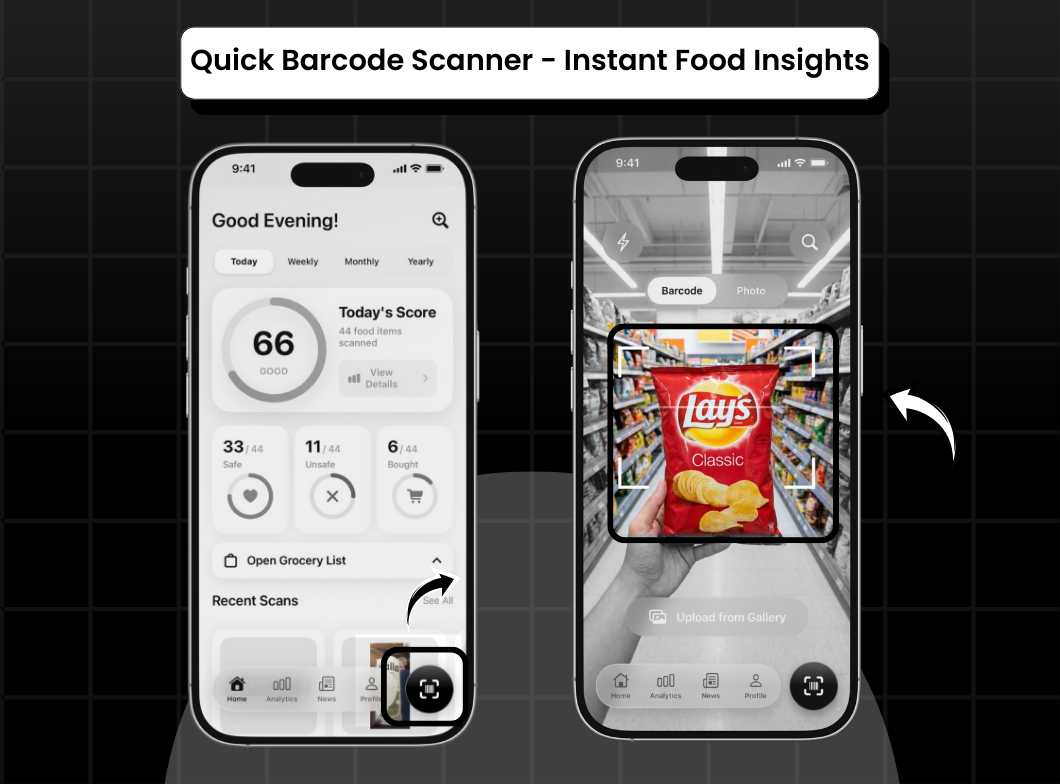
1. Quick Barcode Scanner – Instant Food Insights
Karrot AI uses computer vision to read and analyze ingredient labels directly — even for products not in its database. Point your camera at any ingredient list and get a full breakdown of every additive, preservative, and hidden sugar in plain language.
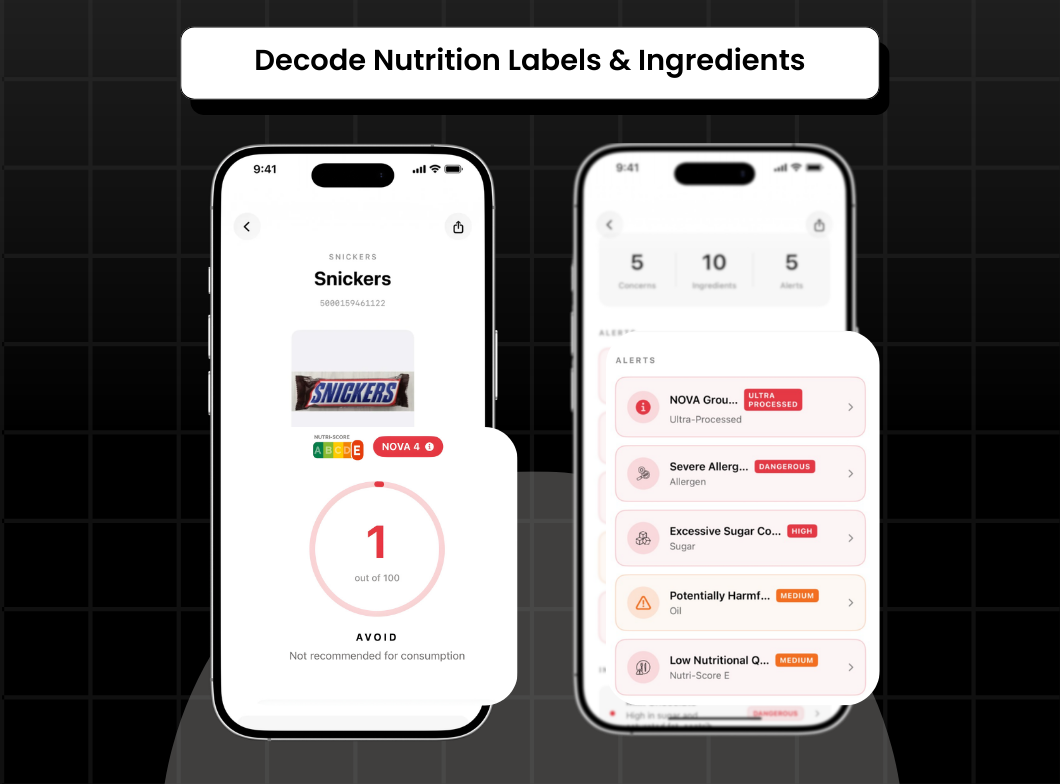
2. Decode Nutrition Labels & Ingredients
Every scanned product gets a NOVA score (1–4) so you can instantly see how processed it is. Karrot flags ultra-processed foods (NOVA 4) and explains exactly why — helping you avoid the products that matter most.
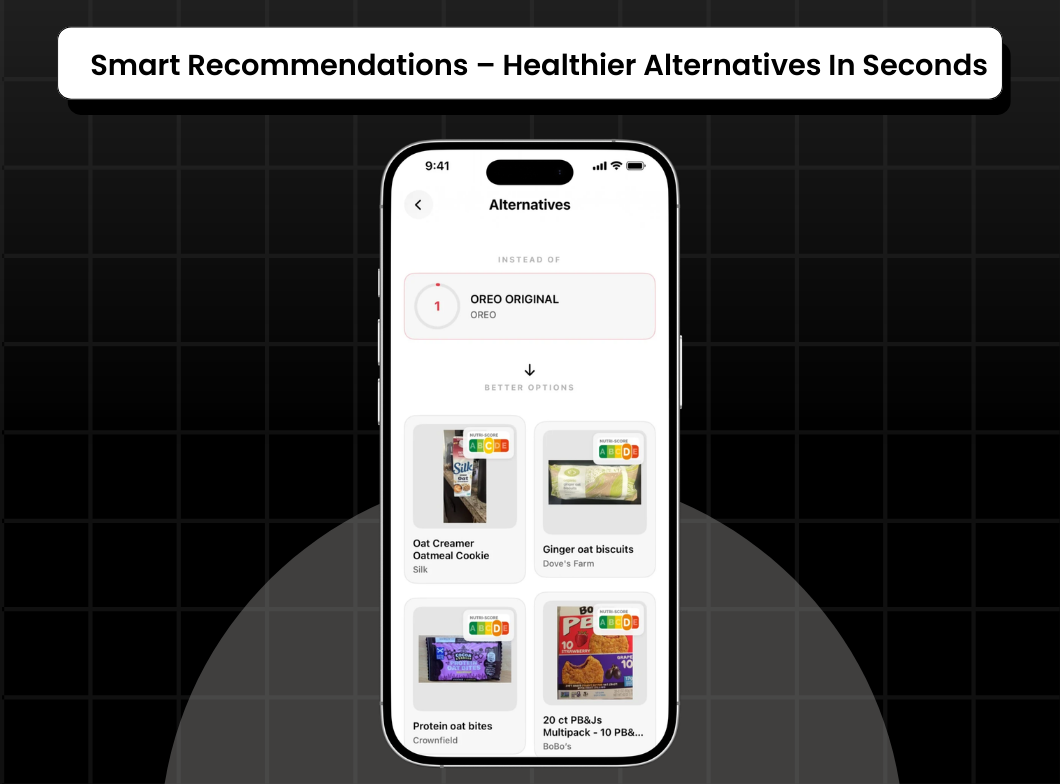
3. Smart Recommendations – Healthier Alternatives in Seconds
Karrot flagged every concerning additive we tested for — Red 40, Yellow 5, sodium benzoate, BHT, carrageenan, and all 56+ names for hidden sugar. Each flag comes with a plain-language explanation of what it is and why it matters.
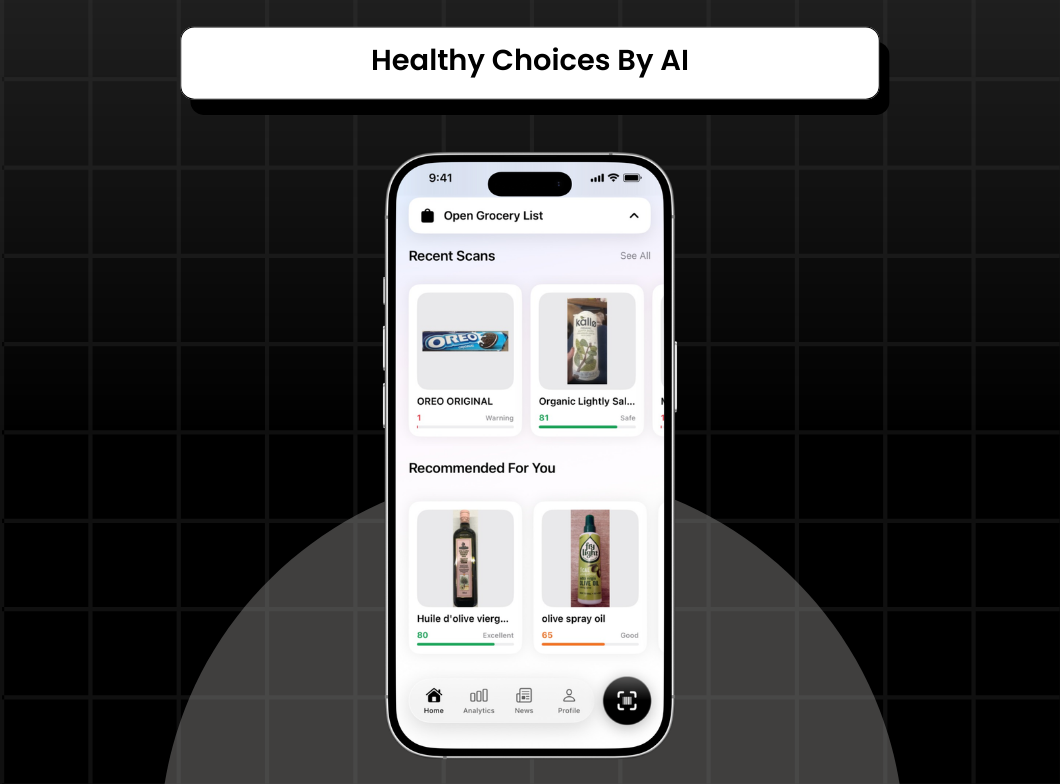
4. Healthy Choices by AI
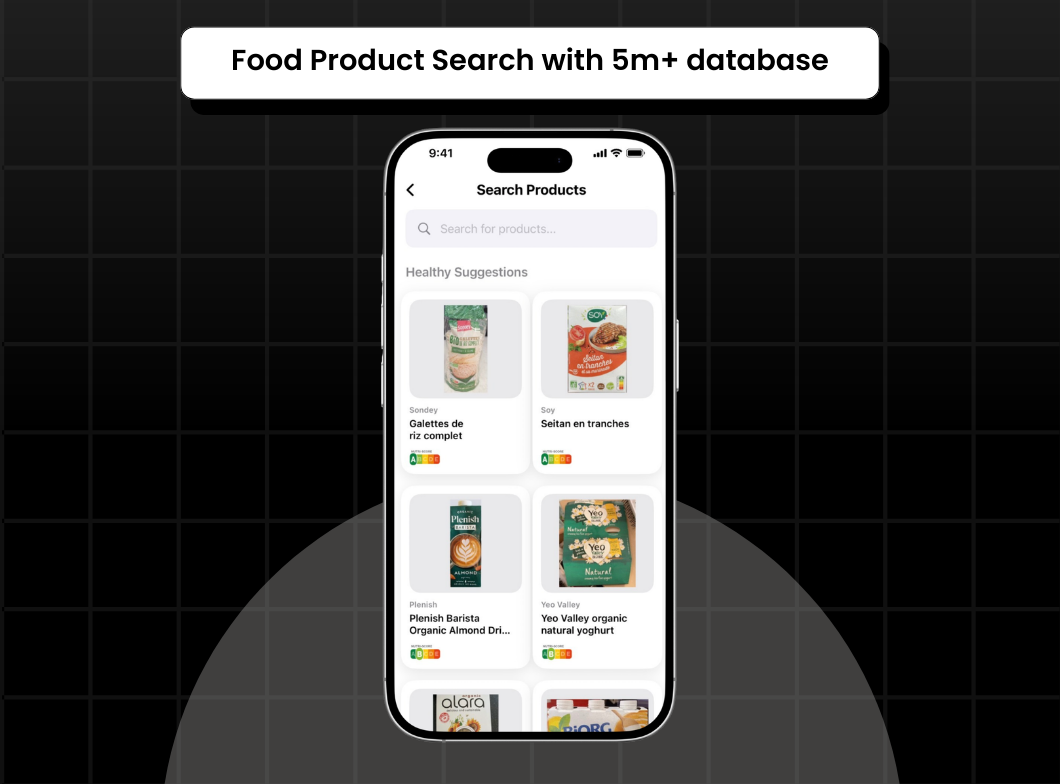
Scan any product via barcode or simply take a photo of the ingredient label. Karrot AI's database covers over 5 million products. In our test, it recognized 24 out of 25 products via barcode and successfully analyzed the 25th through label scanning.
5. Food Product Search with 5m+ database
Set your profile once — gluten-free, nut-free, vegan, lactose intolerant, keto, or any combination — and Karrot instantly alerts you if a product doesn't match. No other app we tested offered this level of customization.
Pros
- AI reads labels directly — works even without barcode
- Largest and most up-to-date product database
- Catches all hidden sugars, dyes, and preservatives
- Personalized dietary alerts
- Clean, modern interface
- NOVA ultra-processed food classification
Cons
- Currently iOS only (Android in development)
- Premium features require subscription
2. Yuka — Best for Simple Scoring
Rating: (4.5/5)
Available on: iOS, Android
Yuka is one of the most well-known food scanner apps, originating in France. It assigns each product a score from 0–100 along with a color-coded rating (excellent, good, mediocre, poor).
Key Features of Yuka
- Simple scoring system — easy to understand at a glance
- Large European database — excellent coverage of European products
- Also scans cosmetics — a nice bonus feature
- Clean interface — well-designed and easy to use
Weaknesses
- US product coverage gaps — we found Yuka couldn't identify 6 of our 25 test products, particularly US-specific brands
- No AI label reading — if a product isn't in the database, you get no results
- Limited additive explanations — flags additives but doesn't always explain them in depth
- No dietary personalization — you can't set allergies or dietary preferences for personalized alerts
- Score can be misleading — the algorithm weighs nutritional content (calories, salt, sugar) heavily, sometimes rating a product as "good" despite containing concerning additives
3. Fooducate — Best for Nutrition Education
Rating: (4.2/5)
Available on: iOS, Android
Fooducate has been around since 2011 and takes an education-first approach. It grades food from A to D and provides explanations of why specific ingredients matter.
Key Features of Fooducate
- Letter grading system (A–D) — intuitive and familiar
- Healthier alternatives — suggests better options in the same product category
- Nutrition tracking — doubles as a calorie and macro tracker
- Good educational content — explains ingredients in context
Weaknesses
- Dated interface — the app feels outdated compared to modern alternatives
- Slower scan speed — noticeably slower than Karrot AI and Yuka
- Smaller database — couldn't identify 8 of our 25 test products
- Additive detection is shallow — catches major offenders but misses many hidden sugars and lesser-known preservatives
- US-focused — limited coverage for international products
- Ads in free version — the free tier includes frequent advertisements
4. Open Food Facts — Best Free & Open-Source Option
Rating: (3.7/5)
Available on: iOS, Android
Open Food Facts is a community-driven, open-source food database. Think of it as the Wikipedia of food products. Anyone can contribute product data, and the app is completely free.
Key Features of Open Food Facts
- 100% free — no premium tier, no ads
- Open-source — fully transparent about methodology
- Nutri-Score integration — uses the European Nutri-Score (A–E) rating
- NOVA classification — includes ultra-processed food scoring
- Massive global database — over 3 million products contributed by users worldwide
Weaknesses
- Data quality varies — since anyone can contribute, some entries are incomplete, outdated, or inaccurate
- No AI scanning — relies entirely on barcode matches in the database
- Clunky interface — the user experience is functional but not polished
- No dietary personalization — limited ability to set personal preferences
- Additive analysis is basic — provides information but doesn't contextualize risks clearly
- Missing products — couldn't identify 9 of our 25 test products
5. Think Dirty — Best for Clean Beauty + Food
Rating: (3.5/5)
Available on: iOS, Android
Think Dirty originally launched as a cosmetics and personal care scanner and later expanded into food. Its primary strength remains in beauty products, but its food scanning has improved.
Key Features of Think Dirty
- Dual-purpose — scan both food and beauty/personal care products
- "Dirty Meter" — a 0–10 rating scale that's easy to understand
- Good for cosmetics — still one of the best apps for scanning skincare and makeup
- Ingredient breakdowns — provides individual ratings for each ingredient
Weaknesses
- Food database is limited — recognized only 11 of our 25 test products
- No AI label reading — completely dependent on barcode database
- No dietary preferences — no way to set allergies or dietary restrictions
- Food analysis feels secondary — the app clearly prioritizes beauty products
- Some inaccurate ratings — we noticed a few products rated as "clean" despite containing controversial additives
- Premium paywall — many features locked behind a subscription
Head-to-Head Comparison
| Feature | Karrot AI | Yuka | Fooducate | Open Food Facts | Think Dirty |
|---|---|---|---|---|---|
| Products recognized (out of 25) | 25 | 19 | 17 | 16 | 11 |
| AI label reading | |||||
| Scan speed | ~1–2s | ~2–3s | ~3–4s | ~2–3s | ~3–5s |
| Dietary personalization | , Full | Basic | |||
| Hidden sugar detection | All 56+ names | Some | Some | Basic | Limited |
| Additive explanations | Detailed | Moderate | Moderate | Basic | Basic |
| NOVA score | |||||
| Healthier alternatives | |||||
| Platform | iOS | iOS, Android | iOS, Android | iOS, Android | iOS, Android |
| Price | Free + Premium | Free + Premium | Free + Premium | Free | Free + Premium |
Our Verdict
If you want the most accurate, fastest, and most comprehensive food scanner available in 2026, Karrot AI is the clear winner. Its AI-powered label reading means it works on virtually any product — even ones not in any database — and its depth of additive analysis is unmatched.
Yuka is a solid second choice, especially if you're in Europe or want a simple score-based system. Fooducate is good for people who want nutrition education and calorie tracking alongside scanning. Open Food Facts is the best free option if you don't mind a rougher experience. Think Dirty is worth it if you primarily scan beauty products and want food scanning as a bonus.
But for anyone serious about understanding what's in their food — especially parents, people with dietary restrictions, or anyone trying to avoid ultra-processed ingredients — Karrot AI is the app to download.
Ready to see what's really in your food? Download Karrot AI and start scanning smarter today.


